

When you think about choosing an MBA program, school culture may not be at the top of your mind as a deciding factor. And yet, for many students, it ends up being one of the things they appreciate most. At Manchester Metropolitan University Business School (UK), the culture of the MBA is not incidental to the program’s design. From how students are selected to how modules are structured to what the school’s building is made of, every layer of the Manchester Met experience reflects a set of clearly held values. Let’s explore what that actually looks like.
A Mission Rooted in Transformation
Manchester Metropolitan University Business School has been educating business professionals since 1889. But its ambition is resolutely forward-looking. The school describes its purpose as transforming lives, businesses, and communities through education and research with a specific focus on developing critical and socially conscious leaders and entrepreneurs. This ethos shapes who the school recruits, what it teaches, and how it measures success.
The MBA program sits within a triple-accredited institution, one of the elite 1% of business schools globally to hold recognition from EQUIS, AACSB, and AMBA simultaneously. That external validation matters. But what drives the internal culture is something more specific: the conviction that business education should create meaningful impact beyond the individual graduate.
Responsibility as a Core Value
At Manchester Met, sustainability is embedded across the entire MBA curriculum and mapped against the United Nations Sustainable Development Goals. The school even asks applicants to articulate their understanding of responsible leadership during the interview stage. Their values can shine through before a student even sets foot in the classroom.
“We want our graduates to, upon completing their studies, go out in the real world and make an immediate positive impact on their careers, their organizations, and their wider societies,” says Dr. Anastasia Kynighou, MBA Director and Associate Professor in HRM at Manchester Metropolitan University: Business School.
That orientation attracts a particular kind of student. According to Dr. Kynighou, many applicants arrive saying that they chose Manchester Met specifically because the school’s values align with their own. This self-selection reinforces the culture from within. Students who enroll are already invested in the idea of leading responsibly. This shapes the conversations in the classroom and the relationships between peers.
Inclusion as Institutional Commitment
The university’s Inclusive and Diverse Culture (IDC) strategy frames equity and belonging not as initiatives but as shared responsibilities. By 2030, Manchester Met aims to build a culture in which every member of the university community – student, staff, and visitor – is treated with fairness, equity, and respect.
“Everyone in our university has a role to play in creating an intentionally inclusive culture, where we all act with compassion and respect to support each other,” says Professor Jenny Watling, Pro-Vice-Chancellor (International) and Chair of the EDI Strategy Board.
The strategy organizes this commitment into four pillars: Leadership Culture and Governance, Inclusive Employee Lifecycle, Inclusive Student Experience, and Celebrating Diversity. For MBA students, the practical result is an environment where different backgrounds, nationalities, and professional experiences are valued as part of the learning experience. The school also offers a Women in Leadership scholarship, providing up to GBP 12,000 in tuition fee support.
Partnership, Not Just Education
Dr. Kynighou describes the Manchester Met MBA as a partnership rather than simply a qualification. That language matters. It reflects a culture in which students are treated as active contributors to their own development.
Every module in the MBA includes a guest lecture from an industry leader, drawn from the UK and internationally. Real case studies and applied projects provide a specific context for students. And the HyFlex delivery model, which allows them to choose whether to attend each session on campus or online, was itself co-created with students and commended for its innovation. The result is a program that takes working professionals seriously, built on the premise that the most valuable learning happens when academic studies meet real-world relevance.
What the Alumni Experience Reveals
Louise Bancroft, now Chief HR Officer at Airswift, returned to Manchester Met to complete her MBA after having studied for her MSc in HR there years earlier. She came back because she trusted the institution. She left with something she hadn’t fully anticipated.
“It gave me the confidence – and credibility – to step into the CHRO role. It’s also elevated my ability to contribute meaningfully at board level, particularly in conversations around growth, value creation and organizational strategy,” Louise Bancroft says.
The relationships formed during the program, she adds, have become some of the most enduring of her career: former cohort members she has since hired, others who have become lifelong friends. This is what a strong MBA culture produces.
The City as Part of the Experience
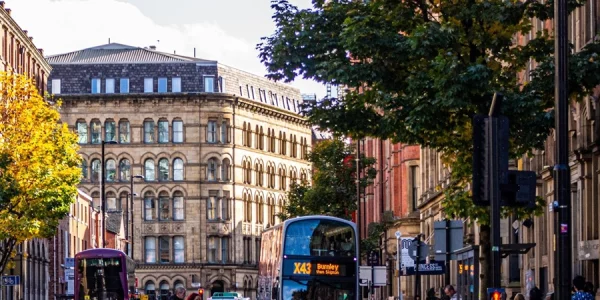
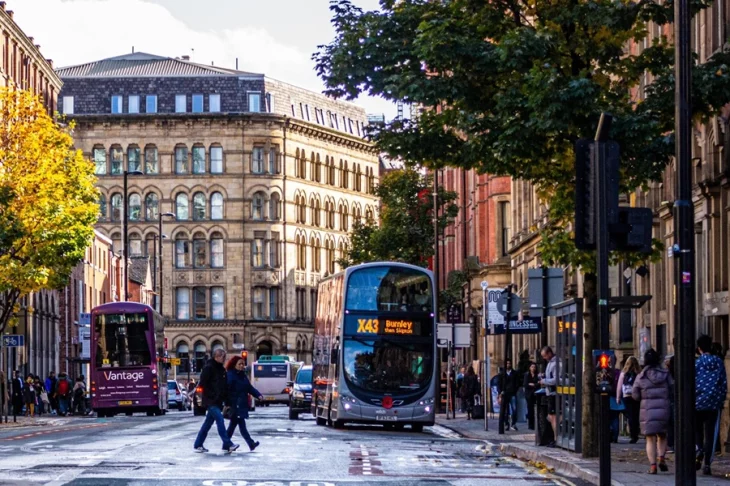
Manchester itself is an extension of the school’s culture. It is one of the UK’s most international and entrepreneurial cities: a place with a thriving tech scene, a rich cultural calendar of concerts, theater, and exhibitions, and a reputation for creative energy. Dr. Kynighou, who studied in Manchester as an international student herself, describes the city’s urban campus as a strong advantage.
“What I loved about being an international student in Manchester is that I was in the heart of the city,” she says, contrasting the experience with the isolation that can come from studying on out-of-town campuses. The school’s building on the All Saints Campus reinforces this ethos: opened in 2012, it holds a BREEAM “Excellent” sustainability rating, featuring green roofs, rainwater harvesting, and extensive natural light.
For prospective students who want an MBA that takes seriously both their professional ambitions and their values, and who want to study in a city that rewards curiosity, Manchester Metropolitan University: Business School offers a culture that means what it says.











Comments