



Veterans with MBA degrees continue to demonstrate how a military MBA transition unlocks leadership opportunities. Alumni from Italy through the US to Australia have successfully leveraged their veteran and MBA experience to reach consulting, corporate, and entrepreneurial roles.
Why Veterans Choose MBAs
The transition from military service to civilian careers presents unique challenges, yet it also offers extraordinary opportunities. For many veterans, an MBA becomes the bridge between these two worlds, providing both the credentials and commercial understanding needed to translate their leadership experience into business success.
Military officers arrive at business school with strengths even seasoned leaders may not possess. They’ve led teams under pressure, made difficult decisions with incomplete information, and managed complex operations with precision. However, as Andrea Teja discovered after 12 years in the Italian Navy, many have “limited knowledge of the business school landscape” and lack exposure to corporate frameworks, financial analysis, and market dynamics.
An MBA can fill these gaps. It teaches veterans to frame their military experience using business language that feels closer or more familiar to corporate recruiters. The degree also opens doors to elite consulting firms and Fortune 500 companies that actively recruit from top MBA programs.
And it’s not just about the credential itself of course. A military to MBA transition exposes veterans to a professional network and a cohort of peers who can help decode corporate culture. For those who have spent entire careers in uniform, this immersion in business thinking and commercial strategy can make all the difference. An MBA enables them to use their unique leadership background while acquiring a new business toolkit.
Transition Stories
Three veterans from different military branches and countries share a common thread: they used MBAs to successfully transition into business environments where they can have an impact. Their experiences show how business school built on their military leadership skills and prepared them for the next chapter in their careers.
Andrea Teja, IMD Business School MBA
 Before:
- 12 years as an officer in the Italian Navy
MBA:
- IMD Business School (Switzerland) MBA
After:
- Management consultant at McKinsey
- Co-founded platform helping veterans transition into business
- Currently Head and Partner at a digital transformation and innovation advisory firm
Perspective/quote:
- He noted that after military service he had “limited knowledge of the business school landscape” before using the MBA to pivot into business and consulting.
Simon O’Brien, Melbourne Business School Executive MBA
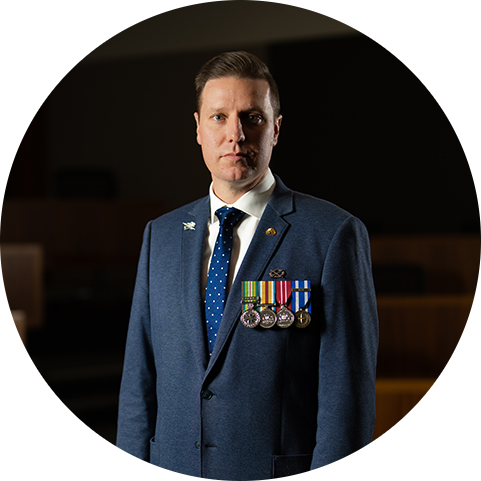 Before:
- Officer in the Royal Australian Armoured Corps
- Led 75 soldiers in Afghanistan combat missions
MBA:
- The University of Melbourne: Melbourne Business School (Australia) Executive MBA
After:
- Project manager → senior corporate roles
- Program Director, Property Transformation (NAB)
Perspective/quote:
“The school was able to consolidate a lot of my knowledge and experience in the first part of my career and overlay a commercial understanding and financial acumen that took my abilities to the next level.”
Tom Nguyen, INSEAD MBA
 Before:
- Australian Army artillery officer
MBA:
- INSEAD (France) MBA
After:
- McKinsey consultant
- Currently into AI Solutions after a career as independent strategy advisor
Perspective/quote:
“When you’ve had that training and come back to the civilian world, you’re not only very experienced in personnel management, but you also have a framework and vocabulary for talking about it in ways that your peers don’t.”
Skills Veterans Bring and What an MBA Adds
Veterans enter business school with leadership capabilities gained in high-stakes environments. They bring discipline honed through training and strategic thinking developed through operational planning. Many of them have team management experience as well. These qualities – decisiveness, adaptability, and the ability to inspire teams toward mission success – are precisely what corporations seek in their leaders.
“Most MBA students have never interacted with someone who has served in the Armed Forces, so veteran representation matters to bring unique perspectives to business schools,” Elle Taylor, a captain in the Army who graduated from Northwestern University: The Kellogg School of Management (US) MBA program, said.
“Veterans bring vast leadership experiences to MBA cohorts that revolve around adversity, high pressure decisions, and adaptability – all lessons that future business leaders will endeavor.”
Yet for all their leadership strength, veterans in MBA programs opt for the business school path because they still need to develop their business acumen. Military careers don’t expose officers to concepts or situations related to competitive strategy, financial modeling, or market analysis. An MBA addresses these gaps and teaches veterans what other frameworks and tools they need for corporate success.
“I didn’t have relevant experience for the industry, and I knew an MBA would prepare me for roles that were beyond typical entry-level analyst positions. […] I also knew that there would be a lot to learn upon starting my new career, but an MBA would provide a baseline business understanding that would make that ramp-up period far more accelerated,” highlights Evan Smith, MPS in Real Estate/MBA from Cornell University: Samuel Curtis Johnson Graduate School of Management (US).
Resources for Veteran Applicants
Recognizing the value veterans bring to their programs, leading business schools have established substantial financial support and dedicated resources to ease the transition from military to business education. The Post-9/11 GI Bill remains the foundation of veteran education funding and it covers tuition and fees at public universities and provides monthly housing allowances. Through the Yellow Ribbon Program, top schools like Wharton, Duke Fuqua, and Tuck offer full tuition coverage.
School-specific initiatives further support veteran students. New York University: Stern School of Business’s Fertitta Veterans MBA Program reduces tuition to USD 30,000 per year for selected participants. Northwestern University: The Kellogg School of Management recently launched the Matt Caldwell Veterans Program to expand recruitment, mid-program support, and career outcomes for veteran students.
It’s not just financial aid – veterans have access to mentoring and veteran clubs at their target schools. Organizations like the Pat Tillman Foundation and AMVETS offer additional scholarships. Veteran student associations provide peer support. Some schools also waive application fees for veterans and offer dedicated admissions counseling.
Prospective applicants should connect with current veteran students early in the process as these connections are incredibly valuable.












Comments